Sunday, November 13, 2005

Elizabeth II: Crusader Queen?

According to recently revealed Al Qaeda videotape, the Queen is Enemy Number One to Islam.

She is responsible for "crusader laws" and is the "severest enemy of Islam". This is risible. The Queen isn't even in charge of the scissors she uses to cut ribbons at openings and she can't even manage to be a "severe enemy" to Islam in her own home. Yes, I've occasionally wondered if Prince Charles is a crypto-islamist, given his fondness for the religion and his frequent public statements in support of it. Daniel Pipes has blogged a dossier suggesting his secret conversion.

His latest update includes snippets from a column by Julie Birchill -

What's not to like about Islam if you're the Prince of Wales?

I wonder why Prince Charles seeks to big up powerful, theocratic Islam — which already controls so much land and wealth and yet will kill and kill to gain more — and not vulnerable, pluralistic Israel? Why doesn't he invest as much energy in defence of the persecuted and murdered Christians who suffer for their beliefs under Islamic regimes?

She then answers her own questions:

Well, I think I know why; because cleaving to Islam is the one way that men who wish to appear liberal and enlightened can promote reactionary ideas. Monarch-worshipping, woman-oppressing, non-democratic — what's there not for Charles to like!

_____
HT: Harry's Place: God Save the Queen

Yesterday in the park

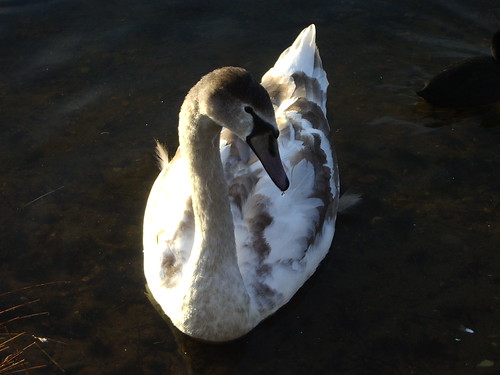
Yesterday in Richmond Deer Park

A young swan

2005-11-13 044

Bracken and berries

2005-11-13 041


Deer

2005-11-13 033 3

Saturday, November 12, 2005

tiff

The Vol-in-Law and I had a little disagreement recently, one of those long running low grade domestic differences of opinion (in this case about the proper approach and style to bed making). We just do not see eye-to-eye on this.

The Vol-in-Law insists he's right and said to me "On this one, I'm the McCain and you're the Cheney."

Ouch.

Friday, November 11, 2005

If you want to play in Texas...

I think they're still smartin' over Prop 2 (The Texas Marriage Amendment) at the Appalachia Alumni Association.

Top 10 Reasons why Gay Marriage should be illegal.

and

Why do I live in Texas?

Gay marriage isn't legal in the UK, but many local authorities are undertaking "blessings" or "unions", which as far as I can tell don't grant you the same rights or entail the same duties as marriage. But marriage isn't that popular among the educated middle classes in the UK anyway. I know many people with mortgages and kids who can't be bothered to sign the damn piece of paper, I guess they don't want to be 'tied down'.

I'm in favor of gay marriage because I'm in favor of marriage. I think that long term stable cohabitation is a good thing for society in general and that we ought to encourage that kind of behaviour in all kinds of people. Plus if I had to do it, I think everyone else should have to do it, too.

In defense of Pat Robertson

Now Pat's said a lot of crazy things, and his latest "It's all over in Dover" stuff is just a hoot.

Pat said:

I'd like to say to the good citizens of Dover: if there is a disaster in your area, don't turn to God, you just rejected Him from your city," Robertson said on his daily television show broadcast from Virginia, "The 700 Club."

"And don't wonder why He hasn't helped you when problems begin, if they begin. I'm not saying they will, but if they do, just remember, you just voted God out of your city. And if that's the case, don't ask for His help because he might not be there," he said.


But I'd like to say something in defense of Pat. Here's something he said during his failed presidential bid that made sense:

[For the children of America].We owe to them the excitement and future potential offered by education and job training that is second to none in the world.
To accomplish this goal we must guarantee --

We will insure to them a return to a basic broad based phonics approach to reading. Our children must learn basic language and basic math. They must know the facts of history --the facts of geography -- the facts of science.

Yes, that's right Pat Roberston said that we gots to teach the kids the facts of science.

Ha ha ha ha ha ha ha ha ha - heee - ha, ha, ha.

(Actually, I totally agree with his support of phonics.)


___________

Tennesseans who wrote on this and inspired me to post: What has Pat been smoking? (Mel's Diner), Oh, Pat : ( (Shanktified), On Robertson, (Say Uncle in kinda sorta a defense),

ViL: Eurabia?

Loads of scary articles in this week's Spectator following the French riots, this one by Mark Steyn on demographics possibly the most powerful:
http://www.spectator.co.uk/article.php?id=6901&page=1

He makes a point that's rarely discussed but seems indubitably true:

"Now go back to that bland statistic you hear a lot these days: ‘about 10 per cent of France’s population is Muslim’. Give or take a million here, a million there, that’s broadly correct, as far as it goes. But the population spread isn’t even. And when it comes to those living in France aged 20 and under, about 30 per cent are said to be Muslim and in the major urban centres about 45 per cent. If it came down to street-by-street fighting, as Michel Gurfinkiel, the editor of Valeurs Actuelles, points out, ‘the combatant ratio in any ethnic war may thus be one to one’ — already, right now, in 2005."

I've seen it said elsewhere that in the Netherlands currently two Muslim babies are born for every one non-Muslim.

What the above figures mean is that even if there were zero net Muslim immigration to France and the Muslim birth rate immediately fell to the general French level, and there was no net conversion to Islam, the French Muslim population would reach 30%. If the Muslim children currently born in the Netherlands reproduce only at the general Dutch level, the Dutch Muslim population will reach 66%.

In fact, Muslim men and women will likely continue to marry spouses from abroad and bring them back to Europe. Some level of Muslim migration into Europe will continue, though I think that may be at a relatively low level except when there's a media-worthy disturbance in a Muslim country like Iraq which makes asylum claims much easier. Non-Muslims will continue to convert to Islam, most commonly women converting to their husbands' religion (although the small number of male converts are a particularly disaffected and potentially dangerous group of people from marginal parts of society). There may be an increase in forced conversions of the kind that have occurred in south London, again these currently affect mostly marginal groups - the 'underclass' or 'vulnerable' groups, in London mostly poor West Indians.

Most importantly though is that on present trends it seems Muslim women are likely to continue to be undereducated and to have many more children on average than non-Muslims. The many young British Muslim women I teach tend to be bright and hard working, noteably more so than the small number of young British Muslim men. Back when I lived in Coventry too (a working class midlands city) when I did menial private-sector work it was noticeable that the young Muslim women in the junior managerial positions seemed much smarter & more competent than their non-Muslim peers , male & female - I don't recall seeing any Muslim men in such roles. Without official positive discrimination in the UK, with likely negative discrimination and with low expectations from their families, I think Muslim Asian women who want a career have had to be better than their contemporaries to get on.

At my University, the one group of Muslim women students who are not noticeably bright & hard working are those wrapped in burkas. There's generally a continuum - a south-Asian student wearing no religious clothes (who may be Hindu) prepares better and does better work than one in hijab headscarf, who in turn does better than one in full burka (no veils yet). It's not just a question of social class or what quality of school they went to, I've had burka wearers with posh accents and upper-middle-class demeanour, outraged that we had given them a low mark for a poor piece of work. But as with the male students, the more they make an ostentatious display of religiosity, the less work they seem prepared to do. This is almost the opposite of what one might expect from a Judaeo-Christian background, where "religious" and "hard working" are often synonymous, though I guess maybe Protestantism and orthodox Judaism maybe emphasise this more than Catholicism. I don't know if the religiosity dicourages hard work, or if lazier personalities are attracted to the religiosity because it can act as a shield against criticism ("Ramadan means I can't do 10am tutorials"). Either way, I do know that not working results in poor levels of achievement, helping create a vicious circle of resentment. Furthermore, the burkas and the male religious dress become much more common in every year upcoming, in my 3rd year class last year I think there was 1 burka and a couple hijab in 40 students; I recently saw a first year class (not mine) where they must have made up over 2/3 of all the students there. 5 years ago, most people thought Muslims were doing pretty well in British society, making a positive contribution. The Bradford riots in summer 2001 started the doubts, and the Muslim reaction to 9/11 started the fear. It still seems that the majority of Muslims in Britain are not radical Islamicist, but it is certainly a powerful political wave in Europe, and growing stronger. George Bush's policies have certainly helped encourage it, while being also stupid and counter-productive (eg: don't bother catching Osama, invade Iraq instead), a view which I suspect Steyn would not agree with.

I don't know what the future will bring - ethnic, political and religious conflicts tend to end, eventually, or at least go dormant - but I am not very hopeful. A sane and competent leader of the USA after 2008 would help. Nothing else looks amenable to easy solution. I hope there are no true mass-fatality attacks on London while I'm living here - none of the kind that kill thousands, anyway, and hopefully none at all. I hope there isn't an intifada here in London, and that if there is it at least stays up beyond Tooting Broadway and not in my immediate vicinity. I hope the police know what they're doing. But I doubt it.

Remembering

Today is Veteran's Day or Remembrance Day. It depends on what side of the Atlantic you sit.

I have to really hand it to the Brits, they run a really good Remembrance Day. For around two weeks before Remembrance Day there are volunteers from the Royal British Legion in stations around the country selling poppies that you can pin to your lapel in advance of Remembrance Day. You can find the poppies for sale on most reception desks in businesses. The poppies are de rigeur for anyone in a suit and for many others besides. Politicians wear them, news presenters wear them, people on the street wear them. I wear one. My site wears one.

Poppies are the symbol of Remembrance Day because poppies are trash plants that thrive in recently disturbed thin topsoil. When the killing fields like Passiondale finally had a season of rest after World War I, they bloomed a sea of red poppies, their roots in the blood of fallen soldiers.

On the 11th of November at 11am, the country comes to a stop for two minutes of silence and reflection. (This photo of a policeman observing silence supplied by Royal British Legion)

But that's not all. The Sunday closest to the 11th (this year the 13th) is called Remembrance Sunday. On this day, wreaths and crosses are laid for the war dead. There is great ceremony to it all. The Queen, the Duke of Edinburgh, the rest of royal family come out and lay wreaths, politicians of all hues come out and lay wreaths (not Sinn Fein, btw) at the Cenotaph at Whitehall. I've never been out to the ceremony itself, but it is televised and broadcast on the radio. (I always listen to it on the radio). That's just the biggest ceremony, but up and down the land there are local ceremonies to local war dead.

If I had a little niggle about Remembrance Day, it's that it is perhaps too focused on the dead. (But since this occasion has its roots in the often careless slaughter of nearly a million of Britain's sons in WWI, I guess I can understand.) They made the ultimate sacrifice, but many have sacrificed much and many others have served. So, during my two minutes of silence, I pause in reflection and gratitude for all who have served and not just for those who gave all. I particularly think about the sacrifices made by people I know and think about how, fortunately, war has not touched my family as hard as it might have.

Both my grandfathers served in WWII (read my grandfather's story of his war time experiences), and both made it through largely unscathed. My dad was drafted during Vietnam, but spent almost all his tour of duty in Oklahoma. My grandmother's older brother managed to survive WWI, only to catch TB in the trenches,pass it on to one of my great aunts and die of it in Tennessee. But largely we've been lucky. Lots of others haven't.

Tag:

Thursday, November 10, 2005

Tortured rhymes, sicko minds

There ain't nothin' like bad poetry. Especially when it's written by teenagers, when it smacks of anti-semitism and when it's distributed to schools across the UK in a book called Great Minds.

What is this poem? - it's called Jews.

And it goes a little like this.

"Jews are here, Jews are there, Jews are almost everywhere,
filling up the darkest places, evil looks upon their faces
....

Make them take many paces for being one of the worst races,
on their way to a gas chamber, where they will sleep in their
manger.


... I'll be happy Jews have died."

I heard the whole thing on the radio last night - more of the same, I'm afraid to say. Though there is a line somewhere about three quarters of the way through the poem which reads something like "I am Adolf Hitler". So that's supposed to make it all ok, you see, because the poem's author - one 14 year old Gideon Taylor is supposed to be putting himself in the mind of Herr Hitler. You see he's empathising with an historical character, it's part of the new style of history teaching in the UK.

Here's more on it in an Associated Press story via Haaretz.com and at Discarded Lies there's a post called "Who is Gideon Taylor?" that raises that very question and quotes Julie Birchill, a British columnist, quite heavily. (Julie's piece is well worth a read). And Labour MP Louise Ellman has got in the act criticising the publication of this poem.

But the publishers have defended the poem's inclusion in the book:

Young Writers editor Steve Twelvetree, who also edited the book, said the
poem was included as it illustrated how the writer was able to empathise with
the infamous Nazi Fuehrer.

Twelvetree told the Telegraph: "From Gideon's poem and my knowledge of the
National Curriculum Key Stage 3 his poem shows a good use of technical writing
and he has written his poem from the perspective of Adolf Hitler.”


Well, I don't have a problem per se with using empathy exercises as a way of teaching History. Nor do I have a problem with trying to get into the mind of a Nazi in a bid to understand how such a thing could happen. In Bill Brown's English class at West End Jr High in Nashville, we all had to empathise with an historical character and compose a little short story. The example he read out in class was from one of his old high school students, who had "empathised" with a Nazi concentration camp guard. It was a powerful piece of writing, and yes it had stuff in there about hating Jews, but it was done in such a way that it wasn't sympathetic and it captured the level of darkness in a soul who could murder fellow human beings on an industrial scale. It was brilliant.

But this poem is just unremittingly bad, chirpy little greeting card verse about gassing Jews. It doesn't really belong in a book to be distributed to schools across the UK.

_________

Here are some thoughts on this by other bloggers:

Dangerously Subversive Dad
Points of Jew
Little Green Footballs

Salsa time

When I get sick, I get ill (ill in the sense of testy and bad tempered). I still have my cold and I am in a bad mood. The littlest thing is likely to tick me off.

So when I noticed a young man in headphones sit down next to me in the tube I was all ready to get upset. I despise musical overleak. Especially the shhh-shhh-shhh of heavy rock or the thunka thunka thunk of hip hop.

But just as I began to detect the first note of his music and felt my hackles rise, I realised it was salsa.

For some reason salsa is the one type of music I don't mind spilling out of someone's house, car or headphones (I also don't mind piano concertos). It lifts my spirits.

I suppose it reminds me of my time living in Puerto Rico when my daily walk or bike ride to school was enlivened by salsa pouring out windows, quickening my pace. Yes, most of it was salsa, but there were also two houses on my route with piano concertos, too.

Wednesday, November 09, 2005

Lose-lose situation

Well everybody loses all around.

Tony Blair loses because Parliament wouldn't give him the 90 days of permissable detention without charge as part of the new Terrorism legislation. And the rest of us lose because now you can be held for 28 days without charge.

That's nearly a month. In February, it is a whole month.

Turns out that part of the reason the Police want this 90 days is because they're not allowed to interview people after charging them.

I didn't know that. But knowing it now it doesn't change my mind. Because they can change the rules to allow the police to question people after they've been charged without changing the laws and without damaging anyone's civil liberties (even those being detained). It's only a matter of guidance (which in centrally controlled state like the UK has nearly the weight of law) and all it would take to fix the problem is to circulate new guidance.

You can find the guidance dealing with detention and questioning here:

The Police and Criminal Evidence Act Code C (PACE) says:

A detainee may not be interviewed about an offence after they have been charged with, or informed they may be prosecuted for it, unless the interview is necessary:
  • to prevent or minimise harm or loss to some other person, or the public
  • to clear up an ambiguity in a previous answer or statement
  • opportunity to comment on, information concerning the offence which has come to in the interests of justice for the detainee to have put to them, and have an light since they were charged or informed they might be prosecuted

The PACE code has been under review since 2002, and they hadn't bothered to change the above guidance. This new draft guidance was uploaded in September and highlights all the changes that have been made. This section, so far as I could see, was untouched.

Change the PACE Code before you start locking people up for a month without charge.

Result!

Well, it's a happy morning (mostly) for those who lean Dem. Both Governor's seats go to Democrats in Virginia and New Jersey, and perhaps by better margins than expected.

Egalia at Tennessee Guerilla Women has the wrap up on that with her usual panache.

But even better, is that voters in Dover, PA booted off the "Intelligent Designers" from the School Board.

The Scientific American blog picks that up in a post called "It's Over in Dover." Cute.

I'm glad to see "Creationism in a White Coat" rejected.

Britain hands over its liberty on a plate

Q: How many days does it take to interview a suspected terrorist?
A: Ninety, apparently.

The UK Labour Government wants legislation which will allow them to hold suspected terrorists for 90 days without charge.

The normal amount is 48 hours, two days, and they can apply for a bit more under the current law, but they want 90 whole days, that's three months, a quarter of a year.

Spy Blog has a good round up of the provisions of the Bill, which are, as you might guess pretty illiberal (see you just can't trust ex-Marxists with your civil liberties, they don't really have the concept of freedom and liberty ingrained in their souls).


Don't glorify terrorism
This same bill has provisions against "glorifying terrorism" (what was it the Houses of Parliament were doing with rather sympathetic Guy Fawkes re-enactment?) to add to the existing (?) provisions on stirring up hatred based on race or religion. I hate this woolly 'stirring up hatred' language. What the heck does that mean? For some people, you'd have to stir pretty darn hard and with a pretty big stick to raise hatred beyond a low simmer. For others, you can watch that pot, and it will still boil over with hatred.

We're on the brink of a state where it's "Don't think it. If you must think it, don't say it. If you must say it, for goodness sake don't write it down. If you write it down, don't be surprised." But I digress...again.

90 Days
But back to the 90 day issue, which is what's drawing the most attention. I might say I wouldn't mind holding people for 90 days without charge if only I trusted that the police and intelligence would use these 90 days sparingly and with the best of intentions, but that's just not the case. I just do not believe that a democracy should be holding people 2 or 3 days (I'd prefer 1 day) without charge. The current limit is 14 days for suspected terrorism (and even then you need special permission for the second week).

But what really, really inflames me about this debate is that the Labour government is spinning against anyone who questions the need for 90 day detention. They are essentially saying that those who question will be to blame if this doesn't pass.

The Independent says:

Mr Blair admitted yesterday he faced defeat over the 90-day plan, but told a Downing Street press conference he believed any compromise forced on him by Labour, Tory and Liberal Democrat MPs would be "a compromise with the nation's security" in the wake of the July bombings in London.

Mr Blair's main reason for wanting this is because 'the police and the security forces have requested it'. And?

They want it because the Crown Prosecution Service is hopeless and slow and they are the ones responsible for bringing charges. They want it because it will make their lives easier, not because it's strictly necessary. Entering our houses without warrants, tapping our phones or allowing to stop and search us without issuing cause (oh wait, they can do that last one) would make their lives easier. But that doesn't mean we should stand for it.

The public swallows it
What I really don't get is why the public seems to have fallen lock step behind this. Few UK bloggers seem to be outraged by this. Here's one who seems to assume that 90 days is just right. And even at Harry's Place, the 90 days are blindly supported. (Fortunately, many commenters aren't so easily swayed, which gives me some hope.)

The Sun is running a big campaign to push through the 90 days and have encouraged their readers to phone a special line in support.

Come on people of England. Don't you understand that when the State takes gross powers to itself it doesn't just use them against people you don't like. They have the power to use it against you, too.

_________

My pal Kathy doesn't support the 90 days.
And here's another blogger who thinks it's a farce


Tags: , , ,

Tuesday, November 08, 2005

I just can't go out that door

We have two locks on our front door. But as of Saturday, one of them quit working. Just wouldn't catch anymore. So tonight Vol-in-Law got out the old power drill and tried to rework the lock. Now normally, I prefer to be in charge of the power drill, but he had the initiative so I let him get on with it.

He resolved to fix the lock by the time the pizza we ordered arrived. He managed to get it to work and pulled the door to, only to discover that we we were now locked in. The latch would not come loose. There's really only one good way out of our house and that's via the front.

Just as we were beginning to panic a little the pizza guy arrived. I had to holler through the door "I'm sorry, we've locked ourselves in."

The Vol-in-Law went round to the front room, stood on the sill and opened the small high front windows. He passed the delivery man the money and the pizza guy reached up and slid the pizza through the window.

To be honest, I wasn't really in the mood to eat by that point, and got out my little mini-crow bar (my favorite tool) and started working on the latch, til I got it to pop off. (The Vol-in-Law had only installed one screw at that point as a test it was in the right place).

Looks like we have another errand to add to our list this weekend.

Granddad blogging: Tiger Tanks

Last week in Granddad blogging, my grandfather describes his time in the Colmar Pocket and taking prisoners. This week, the fighting heats up, and he and a few men hold out against the force of the German Tiger Tanks.

I'd also like to take the opportunity to point out the new button in the side bar. It's the Poppy Appeal for the Royal British Legion, a charity to support British former soldiers or their bereaved spouses and dependants. The Poppy Appeal is an annual fundraising effort which is part of the 11 November Remembrance.

_____________

Then we moved again, we go somewhere, I don’t even know where, right down close to the Colmar canal. I later found out, I didn’t know it then. And they told us we were going to attack some Germans up in the woods up there. That the Germans had tanks and that we had tanks and they took a whole bunch of people and sent them across a little stream and bridge to go up there to attack these Germans up there.

And our company was the last company that was to go up. We were the reserve, this company, we were to hold. So they all go up there, and then here comes the tanks – our tanks – went across this little bridge. The Engineers were up there and they argue around and they finally decide that it’s stout enough to hold us and the tanks and so they said to go on across. They did and they got right in the middle of the bridge and down she went.

Well all of our whole regiment was up ahead of us and another regiment too, I think there were a whole lot of soldiers were up there and we were the last thing. So they carried us across that little river, or we had to walk across it and they told us to dig in. And the little anti-tank gun – 47 mm – one and I don’t know – probably a dozen of us in this platoon dug in five or six holes. Two men to a hole, three to a hole, something like that. And they said you all stay right here and hold. You’re the rear guard.

Well, just about dark here come a bunch of soldiers back through us. And we say “What you all doing? What you coming back for?” They said “Well the Germans got tanks up there and we don’t got any tanks. We can’t fight those tanks.” Well, OK.

In a little bit, we looked up and here come another bunch and we asked them and they said “The tanks are coming. The tanks are coming.” And they’re running back, running back and we call our headquarters and ask ‘em if we can come back. And they said “No sir, you stay right there til everybody up there in that woods gets through. And when they get through then we’ll call y’all back.”

Well, so we stayed. I’d never seen a German tank. I didn’t know what they looked like. But I heard the durndest racket coming down out of the woods and there were two great big old German tiger tanks. And we didn’t do anything. We just looked at them.

But that little anti-tank gun, it shot at one of them and missed it. So he raised his sights up a little and shot at it again and hit it just as center as you could hit one. And it was just like you hit it with a BB gun. It just bounced off. The old German turned around and fired one shot at that anti-tank gun and I can remember seeing the gun and the people and everything else going up in there.

And here comes the tank on down to right where that gun was and they get out of the tank and they’re yakking and talking about something – I don’t know what. But sum total and substance of it was that they’re gonna look up down this river and see if there’s anything else. There were three of us there, and we knew we couldn’t stay there. We’d be killed or captured one. So we threw everything away, but two grenades a piece. Our rifles our packs, everything. I kept a fountain pen, for some reason, that I’d brought with me. That’s the last thing I had left that I’d brought from the States. And we were gonna swim that river.

Well that little old river wasn’t but about neck deep, so we just waded across that little old river and snow was five or six feet deep – maybe that’s too much. It was deep, on the other side of the river. So we get across the river and we laid down and we crawled through that snow back to that bridge where the tanks are broken down.

We later found out that a lot of the soldiers that retreated across the bridge were killed because the Germans had zeroed in on it with machine guns when they went across they shot ‘em off this bridge. Including the boy whose hair I’d cut about an hour before. But when we get to the bridge the Germans had quit shootin’ at it for some reason and we go on across and there are quite a few soldiers lined up on the other side of the bridge. I reckon they were expecting the Germans to counter attack or something, I don’t know what. But they told us to get there, too.

________

Read the first post
Read the previous post
Read the next post
Go to the granddad blogging portal page

Technorati tags: , ,

ViL: "people in England"

"And men in England now abed shall think themselves accursed they were not here, and hold their manhoods cheap" - Henry V

"people in England persist in fighting back when they see others trashing their property or their friends" - Englishman living in France

This was certainly true in my native Northern Ireland in the late '60s, where riots by Catholic Irish Nationalists met a violent response from Protestant Ulster Loyalists which resulted in the British army being sent into NI ironically to protect the Catholics (who wanted Brits out of a united Ireland) from the Protestants. This didn't work out very well as the IRA used the British troop presence as a handy target to justify its incipient terrorist campaign.

Over in America, it's been said that the black Civil Rights movement of the same era was so successful because of its non-violent emphasis. Where the white South would have reacted with extreme violence to an armed uprising from the black South, it was unable to withstand the non-violent methods that Gandhi had used successfully against the British in India.

So, I think it's true, there's something in the Anglo-Saxon character that refuses to knuckle down when violence is directed against it (and arguably sometimes over-reacts). That this is not true of most other groups was demonstrated by the aftermath of the Madrid bombings, many Anglo-Saxon commentators were amazed by the reaction of the Spanish people. I support the right of the Spanish people to vote for whover they want, but in similar circumstances it's very hard to imagine Anglo-Saxon nations voting for an anti-war party.

ViL: Islamist rioters?

Andrew Sullivan writes:

"NOT EXACTLY ISLAMIST: I'm concerned about Muslim extremism in Europe and fear the worst. But I have to say that the reporting so far from France does not conform very closely to fears of an explicitly Islamist insurrection. I found this post by Iain Murray very helpful. And this quote struck me as telling:

They complained that police manhandle them during identity card checks, even claiming that some officers plant hashish on them as a pretext for arrests, and that they regularly fire off rubber pellets during sweeps. "You wear these clothes, with this color skin and you're automatically a target for police," said Ahmed, 18, pointing to his mates in Izod polo shirts, Nike sneakers and San Antonio Spurs T-shirts.

San Antonio Spurs? Not exactly Osama-wear."

This is an easy error to make, but the Paris rioters fit the Islamist actuality (not stereotype) very well, including their mode of dress.
See this brilliant article by Theodore Dalrymple, which really hits the nail on the head:

http://www.city-journal.org/html/15_4_suicide_bombers.html

Why the UK won't riot like the French?

Last night when I was thinking about a could it happen here?, UK v. France analysis, I thought - thank goodness, at least no one's said "it couldn't happen here, we're so much better than that..." which is usually a precursor, sooner or later, to it happening. The British are particularly prone to do this. For example, after 9/11 it was "It couldn't happen here, those Americans don't understand airport security*, they get on planes like we get on buses." But last night on tv, I heard someone say it "No, it could never happen here," but without much reason for why that was the case.

I always want to shake the commenter by the lapels and say "Listen up, you complacent SOB, so long as you say that and don't take steps to avoid a similar fate, it can and it will happen here."

Social conditions in the UK are different from those in France, so it probably wouldn't happen here in exactly the same way. An Englishman living in France comments on the French riots, here, here and here (well pretty much all over his blog recently as you might expect). He has been observing the public disorder from the Cote d'Azur (which must be a good vantage point even at the worst of times).

But he has a specific post on "why it couldn't happen in the UK", that doesn't rely on easy certainties and observes the English national character well. (Emphasis all mine)


However my deeper point, and I'm getting to it finally, is that there is one other difference between England and France and that is that, despite attempts by the multicultis and the police, people in England persist in fighting back when they see others trashing their property or their friends. Furthermore, as we have seen in now and again, while English people are generally law abiding and tolerant, there is a long history of fighting which means that immigrants who want to have a riot get attacked by native rioters who are just as deadly. I do believe that on the whole England will not suffer from the French disease even if the rest of Europe succumbs. The threat of retaliation, unfortunately demonstrated in the increase in "paki-bashing" after July 7th, is also key. If the "muslim community" in the UK starts burning things outside its own ghettoes it will face a spontaneous response that will require that the police actually defend the immigrants.


Of course, does this act as a deterrent or does this lead to full scale civil war should something similar happen here?

A view on the 'bellicose Brits' from my British husband here.
__________________

*post 9/11 we've inadvertently gotten knives through airport security at two different British airports. Once on a domestic flight and once on an international flight to Holland. On one occasion the security guy fingered the Vol-in-Law's knife and then handed it back to him.

Monday, November 07, 2005

Write on Tennessee

I just wanted to note the article on East Tennessee/ Tennessee blogs (registration required) Michael Silence published in the Knoxville News Sentinel.

Something I didn't know:

Media Bloggers Association President Robert A. Cox said the RTB was the first "state association" of bloggers he'd heard of.

"Tennessee has a disproportionate number of well-known bloggers," Cox said


...and...

"I can't think of another area of the country that has as active of a blogosphere as Tennessee," said Middle Tennessee blogger Matthew White of http://www.southendgrounds.com/.

But I have to say it doesn't surprise. Tennessee is such a literary state, that it's hardly surprising that we do well in a media dominated by the written word.

The Tennessee blogging community has meant that even thousands of miles away I can feel close to home.

French riots

It's had to be a light blogging day for me. I've had a ton of work, paid and voluntary, and my cold is pretty rotten.

I note that there's been a fair bit of blogging on the French riots.

Michael Silence has a round up of the Tennessee blogosphere reaction.

I've been thinking about it a lot, but I don't really know what to say. The squalid immigrant suburbs of French cities have always been a bit of a powder keg. Throw in probably justified resentment at French discrimination against les Arabes, incredible unemployment rates, add a little radical Islam, some stupid catalyst incident - et voila - riots.

We've had some inter-ethnic rioting here recently between Asian Muslims and Black West Indians in the Birmingham area, but the causes were entirely different and it played out pretty fast. (Of course, it didn't take us nearly two weeks for someone to die, we got that in the first night, proving British efficiency)

It's hard to judge if something like the French riots could spill across the Channel and happen here. But if it did, I could bet that my neighbourhood would be one of the areas to experience disturbances. There have been several terror arrests in my area and one local man is still awaiting extradition to the US on terror charges.

Let's see what some of the factors behind the riots in France are and how likely we are to experience something like this here in the UK:

Fascistic policing of 'brown people'

Well, I'm sure it's not as bad as in France. And the Brits are very careful to stop and search a quota of white folks, too, as the Vol-in-Law can attest. But many Asians here believe that they are being targeted by the police (and maybe they are).

Segregated neighbourhoods cut off from the economy of the city
Not so much. At least not in London. Most areas are reasonably mixed, and if they are 'monocultural' they usually have reasonable links to the urban centre. But many other cities in the UK are very segregated.

High unemployment
It's not too bad. But Asians find it more difficult to get jobs. The unemployment rate for Muslim youths is significantly higher than for whites. There is some increasing resentment over this. I think it's largely because the schools in their areas are crap.

A history of animosity between ethnic groups.
Some and growing.

Radical Islam.
Oh, yes. A big tick by that one. We have that here. And no one seems to want to address it.


______

Further posting on this topic by me and the Vol-in-Law: here, here and here.

Sunday, November 06, 2005

London 5/11

We did manage to get out to the Guy Fawkes exhibit at the Houses of Parliament. The Vol-in-Law and I met the Texan, who had only just the day before received her permanent leave to remain in the UK. (Basically the US equivalent to the Green Card). She was very excited because it means that she can quit her job and she won't have to leave the country. I thought a little British history would be the ideal way to celebrate.

Since yesterday was the 400th anniversary of the failed plot to blow up the houses of parliament, I expected things to be a little crowded. The queue to get into Parliament was long.
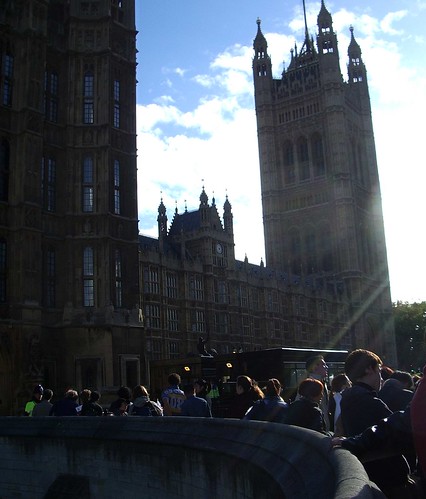
IMGP0391 crop


But it was moving relatively quickly. When we finally got to the top of the line we were met by the cop in the high visibility jacket whom you might be able to make out in the photo above.

He was very cheerful and asked us what we had come to see. He was clutching one of the Gunpowder Plot brochures, and we said we were there for that, but I asked "Why? Are there any other options?"

He said "No, but a lot of people think this is Westminster Abbey and stand in line for 40 minutes before they get to me and I tell them it's not."

"Do they leave with a smile?" I said.

I know he had heard me and the Texan talking in our American accents and assumed that we were foreign tourists. That's a fair assumption, we're both foreign and tourists but we're residents, too.

For those unfamiliar with London landmarks, as we stood in the queue Westminster Abbey was directly behind us and had bells ringing continuously (for commemoration of the 5th of November), it's a big old building and hard to miss. As you exit the local tube station, there are signs pointing you to the Abbey or the Houses of Parliament. I suppose that some confusion could be created due to the fact that the Houses of Parliament are also called the Palace of Westminster - and it's true that there are no signs saying "This is Parliament - you are here".

To me, it seems obvious, but I guess some people don't know the local landmarks. For example, when I was waiting to meet the Vol-in-Law one day (when we meet up in the Westminster area, we usually choose to meet in front of Parliament, beneath the statue of Oliver Cromwell) I was approached by an American who pointed vaguely in the direction Ollie and said "What's that?"

I said "That's a statue of Oliver Cromwell." I was fully prepared to go into a bit of a lecture about Mr Cromwell, the execution of the King, and England's brief period as a Republic. But he said "No, what's that?" and then waved generally at the building.

"That's the parliament building," I said, a bit dumbfounded. I thought it was so obvious that I wondered if I were on one of those candid camera tv shows. Then he pointed up at the giant clock tower and said "What's that?"

"Big Ben" I replied*.

Anyway, when we got past the head of the line - we got to another line. The one for the security hut. Our bags were scanned and we were subject to the full body frisk. When I first went to the Parliament building over nine years ago, we just walked in. Sure we had to speak to the cop at the door, but once we were in we were subject to very little scrutiny. When we got to Strangers' Gallery at House of Lords I was simply asked to check in my camera. This was after there had been a successful car bombing at Parliament, but before 9/11.

From the NPR timeline "Exposive London":

In June 1974 , the IRA bombs the House of Parliament, causing extensive damage and injuring 11 people.

and

March 30, 1979: A car bomb outside the House of Commons kills Airey Neave, the secretary of state for Northern Ireland. The Irish National Liberation Army, an Irish republican paramilitary group associated with the Irish Republican Socialist Party, claims responsibility.


And it wasn't until relatively recently that there were concrete barriers to protect against car bombing.

Anyway, we finally get in to the Palace of Westminster, but there's no time to take in the view. We are directed immediately to what I think is the Great Hall...
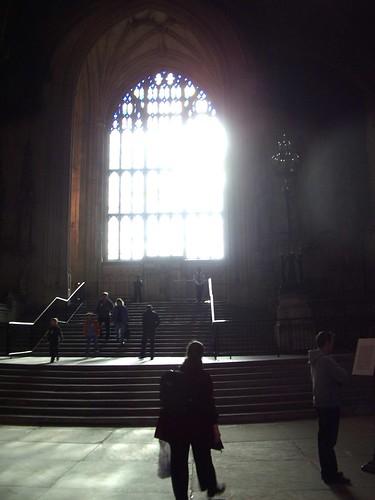
great hall Westminster


...just in time to see the last few minutes of an actor playing Guy Fawkes, explaining the plot and addressing us as if we were co-conspirators. The picture is dreadful, but you get the idea.
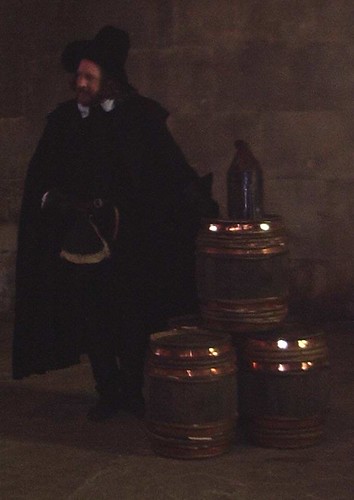
guy fawkes

And here's an effigy of Guy Fawkes - ones nearly as fancy as these are burned every year in the larger 5 November festivals.
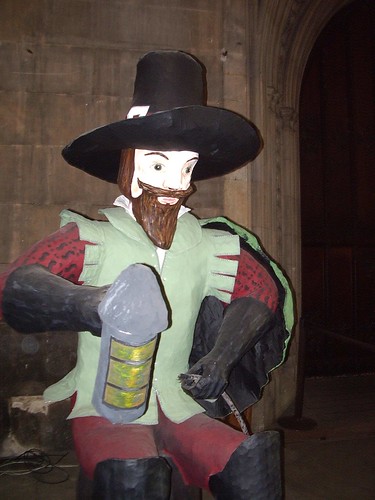
fawkes effigy

You can see the fuse he planned to set and the horn lantern he held when he was found.

There was a good informative exhibit outlining the sectarian strife and providing background on the Gunpowder Plot and why it has been celebrated ever since.. The exhibit included a key to cellar where he rented and stored the gunpowder and lantern he was found with (but both were carefully labelled "said to"). They key was particularly dubious, because it was found in the ashes of the previous Parliament building when it burned down and only during the 20th century was the key associated with Guy Fawkes. But I guess they were hard up for tangible goods.

I hadn't realised quite how much the event was spun at the time. By the end of November 1605, books had been published which contained the speech the King was to give that night and background to the plot. The foiled terrorism was used to foment more animosity toward Catholics, though I don't imagine much encouragement was needed.

This year, I many people are drawing parallels between 5/11 (dates in the UK go Day/Month/Year) and 9/11. One of my fellow expat bloggers has something to say about that. Yes, 5/11 might have been worse had it succeeded - the entire Royal Family and most of the ruling classes would have been killed and probably much of the Westminster area would have burned to the ground. Nearly as many people would have been killed and as much property damaged. But the key difference of course is that it didn't succeed.

There are some other parallels, of course. After Guy Fawkes was captured, he was tortured. This wasn't automatic. King James I had to authorise the torture personally and it was to be used only after the regular interrogation failed. Here are pictures of his signature before, during and after his interrogation and torture (for no, he would not talk).


As we left the exhibit we, of course, checked out the Houses of Parliament gift shop. You can buy House of Commons whisky and a flask to put it in (for those extra long legislative sessions), cuff links, scarves, notebooks, Christmas ornaments and fridge magnets. I bought nothing. When we finally left the hall, there was an amazing view of Big Ben and the London Eye.
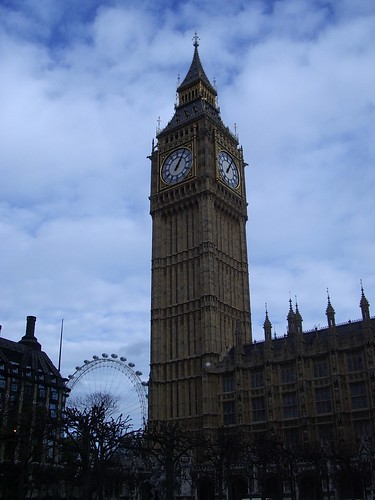
Big Ben London Eye


The Texan was desperate for Dim Sum at this point so we walked up past Whitehall, St James Park, when we got to the Mall we saw a most disturbing sight. The Mall was lined with British and Chinese flags. (Apparently the Chinese premiere is visiting later this week.) I'd seen this once before so it wasn't so shocking this time. But I really disapprove of flying the communist Chinese flag as if Britain were some kind of vanquished collaborator.
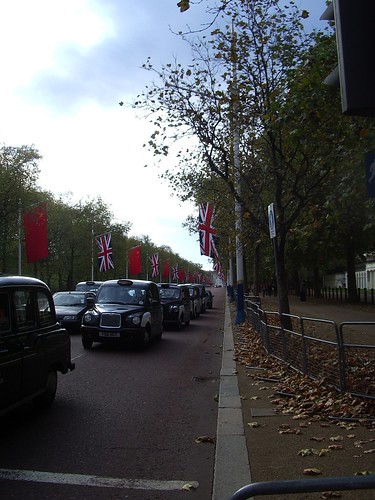
The Mall


So after that we headed up to London's China town to enjoy a lengthy meal of Dim Sum at the Texan's favorite Dim Sum restaurant "Gerrard's Corner". I have to say it certainly was tasty. But as I was sitting in the restaurant I started to feel a nasty cold coming on, which I now have, and which has caused this post to be a bit rambling. Below is a picture of the main street in London's China town.
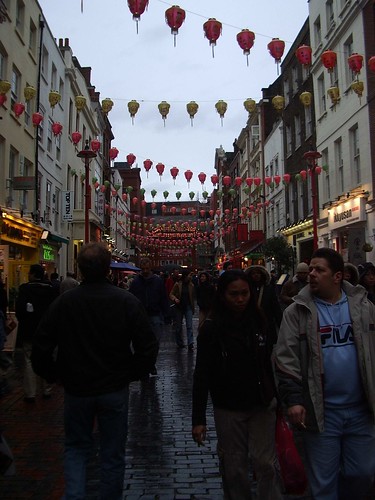
London chinatown

We walked back through London and through Trafalgar Square to Waterloo Station and home again. And now my cold is really bad.

*Update: It has been pointed out that the bell inside the clock tower is Big Ben - not the tower itself. True.